Should Coachella Be in Your U.S. Plan 2027?
Questions to answer before the budget conversation - a field guide for founders and CMOs of mid-sized European lifestyle brands.
By Yvonne Busch & Jessica Kuehefuss
If you're running a mid-sized European lifestyle brand and mapping the next 18 months of U.S. launch or expansion, chances are someone on your team has already put "Coachella 2027" on the radar. Here's the short version of whether that's a good idea and what to weigh before it becomes a line item.
What you're being sold
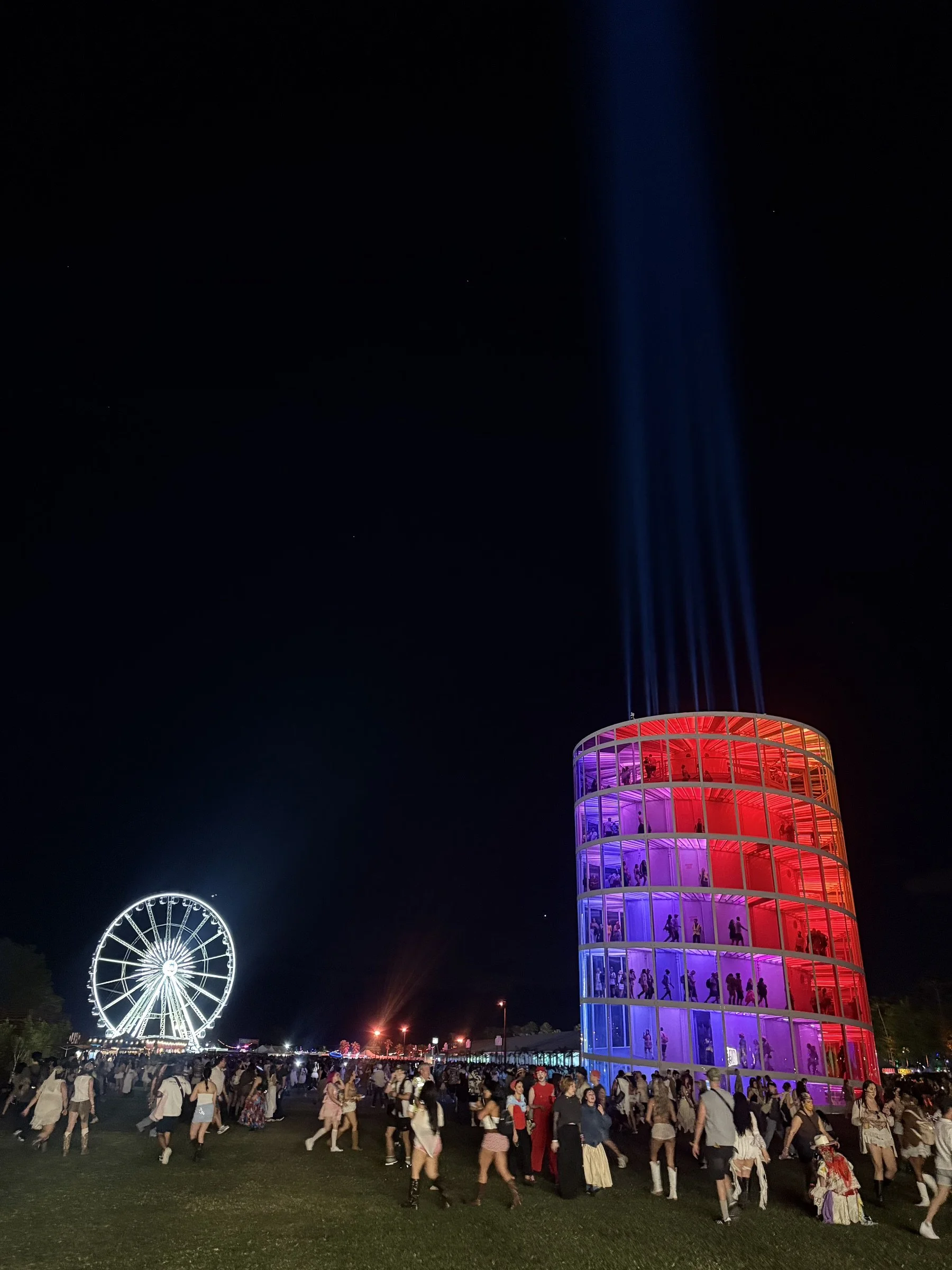
Our colleague Jessica spent both weekends of Coachella 2026 on the ground. What she saw this year confirms what the industry has been edging toward for some time: Coachella is no longer a music festival with sponsors. It's a two-week consumer trade fair with a concert attached. The on-site activations like Pinterest’s phone-free experience with e.l.f. Cosmetics or Gap's Hoodie House are operating at budgets that rival headline artist fees. Off-site, Palm Springs becomes a parallel ecosystem of branded villa takeovers, private dinners, and influencer houses. Revolve Festival. Camp Poosh. Neon Carnival. Or Hailey Bieber’s Rhode's mini festival.
"Activations from brands like Starbucks, Barbie, and Medicube had hours-long lines. Instead of watching artists, thousands of visitors were willing to wait up to two hours to get a special drink or take a selfie. For brands, it's all about accessibility, hype, and offering something unique and experiential in order to stand out."
— Jessica
When a brand considers being part of Coachella 2027, it's buying into this ecosystem. A credible on-site presence starts in the low seven figures and climbs fast. A competent off-site villa activation runs in the mid-six figures. A gifting suite slot - the option most mid-sized European brands get offered - is "cheap" in comparison but delivers almost nothing.

When Coachella actually is the right call
There is a specific profile where Coachella makes sense for a European mid-sized brand:
Category fit: You're in beauty, food and beverage, fashion, tech, entertainment or wellness — categories where festival context is culturally native.
Audience fit: Your target consumer shows up at Coachella - Gen Z and younger millennials, roughly 18–34, culturally plugged into festival, beauty, and creator content.
Market readiness: You've been in the U.S. market long enough to have a real creator bench (typically 12+ months).
Product fit: Your product has something that comes alive in person - a taste, a texture, a smell, a hands-on moment, a statement.
Infrastructure: Your U.S. distribution and digital infrastructure are conversion-ready.
Budget discipline: You can commit to a three-phase budget: pre-event creator seeding, the activation itself, and significant post-event amplification.
One important caveat on the product-fit point: experiential doesn't have to mean the product itself. Sometimes it's how the brand shows up in the landscape.
"Even if your product isn't experiential, you can still ride the momentum. Masters of the Universe promoted their new film with a drone show at night in Palm Springs, right next to the road. Hundreds of drones lit up the sky, people instantly pulled out their phones, and started filming. The drones kept forming new messages, some even tailored to the people driving by."— Jessica
The point: ambition matters more than category. A brand whose product doesn't naturally invite tasting or touching can still create a moment — if the creative is big enough to justify the detour. Most mid-sized European brands don't have the budget for drone shows, but the principle scales down: find the format that earns attention in the environment you're showing up in.
What to do instead
For most European mid-sized lifestyle brands, the better U.S. calendar could look like this>
Year one of U.S. presence: Invest in a creator bench and relationships with the U.S. key voices relevant to your category. Host a small, curated trade or press dinner tied to an industry moment that matches your brand - Natural Products Expo West for wellness, NYFW for fashion, Art Basel Miami for design-forward lifestyle.
Year two: A targeted off-site play around a cultural tentpole your category actually lives inside. Sometimes that's Coachella. Often it isn't. For a German beverage brand, it's more likely Tales of the Cocktail or a Miami Art Week dinner. For a Scandinavian home goods brand, it's WantedDesign or ICFF. For a DACH baby-care brand, it's the Babylist Registry Weekend.
Year three: If the creator bench is real and the brand has earned cultural footing, then consider a Coachella-adjacent play - maybe hosting a villa dinner, not an on-site presence.
The European advantage
The U.S. market rewards four things from any brand arriving at its gates:
A clear point of view, a sequenced funnel, a long runway of relationships, and a budget.
American giants often lead with the fourth. Most European mid-sized brands arrive without any of the four - small U.S. budgets, no local contacts, no sequenced plan, and under pressure to show traction fast. That's the honest starting point for most of the founders and CMOs we work with.
The good news is that the one thing that can't be bought: a clear point of view - is almost always already there. European lifestyle brands are built on distinct perspectives. The rest is buildable: relationships can be seeded, funnels can be sequenced, and patience can be structured into a phased plan that protects the brand while it earns its footing in the U.S.
The real advantage isn't matching American scale. It's arriving with clarity about what you bring - and having a partner who knows how to build the rest around it.
Don't compete where you can't win. Deploy what you already have.